

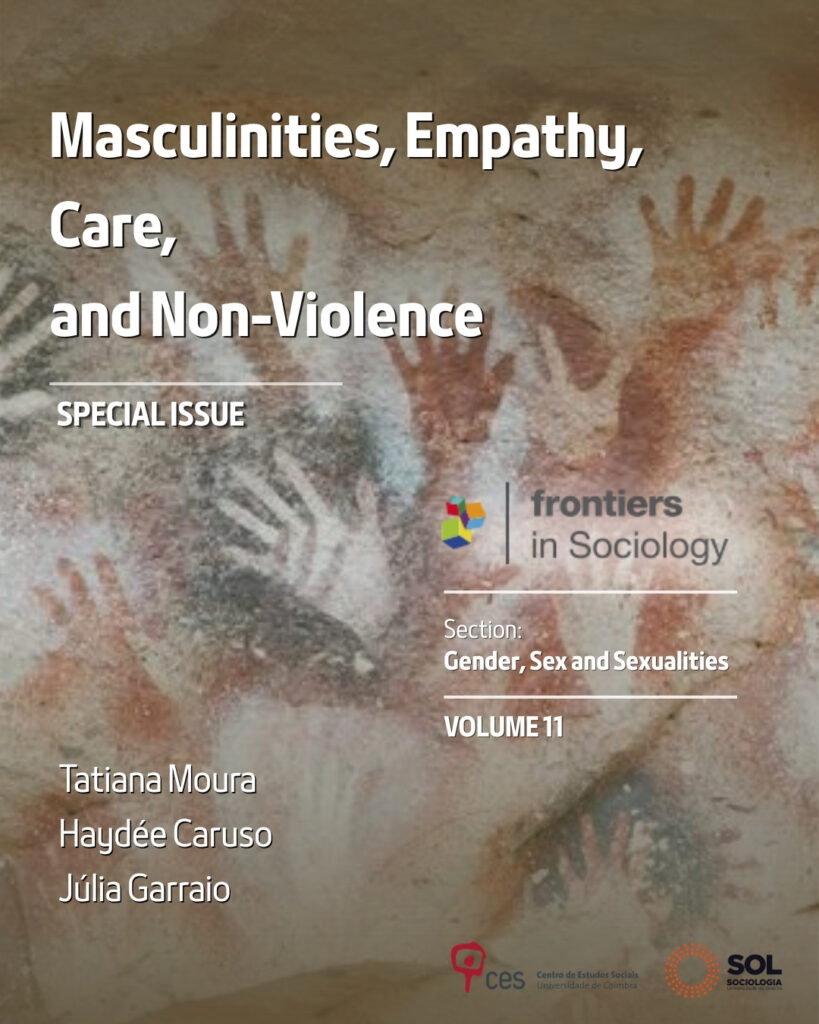
Este número especial do Frontiers in Sociology reformula as masculinidades ao colocar a empatia, o cuidado e a não violência como essenciais para prevenir e interromper a violência de género. Reunindo sete estudos empíricos de Portugal, Espanha e Croácia, a coletânea destaca os/as adolescentes, incluindo jovens em contextos de acolhimento institucional e menores migrantes não acompanhados, como atores centrais cujos repertórios emocionais e trajetórias sociais moldam as futuras relações de género.
Para além da crítica à masculinidade hegemónica, os artigos propõem uma agenda construtiva e feminista: promover masculinidades cuidadoras, práticas profissionais sensíveis ao trauma e com abordagem de género, e metodologias participativas e criativas que tratam jovens como sujeitos e não como objetos.
As análises interseccionais mostram como o lugar, a migração, a raça, a sexualidade e os contextos institucionais produzem experiências masculinas divergentes, enquanto a investigação no contexto da pandemia evidencia como as crises tornam particularmente visível a presença ou ausência de cuidado.
Em conjunto, todas as contribuições oferecem implicações claras para a educação, a intervenção social e para políticas públicas, e apelam a uma investigação comparativa contínua para ampliar práticas transformadoras em diferentes contextos.
Artigos e autorias incluídas:
• Moura, Tatiana — “Transforming harmful representations, investigating violence and empowering care practices in masculinities.”
• Mascarenhas, Marta — “Straight from foster care to the youth detention center? The (mis)paths of child protection and juvenile justice policies in the construction of violent masculinities.”
• Ferreira, Patrícia — “‘I stayed on the street, as if there was no COVID-19’: enacting practices of care with youth at risk of violence and social exclusion in Portugal.”
• Caruso, Haydée — “When fiction meets reality: ethnofiction as a way of constructing youth narratives about delinquent paths.”
• Alonso, Bakea, Longo, Valentina and Garriga, Alvaro Ruiz — “Embodying two shores of the Mediterranean Sea: the liminal masculinity of minors migrating alone to Spain.”
• Matković, Elizabeta, Borić, Ivana and Sočo Anamarija — “Challenging the status quo: gender norms in Croatian juvenile correctional settings.”
• Santos, Sofia José, Garraio, Júlia, Carvalho, Bárbara Janiques — “Caring masculinities and the politics of feminist representation in the Portuguese media.”
Esperamos que seja uma leitura importante para a academia, profissionais e decisores/as políticos/as comprometidos/as com a construção de futuros não violentos e baseados no cuidado, oferecendo perspetivas ousadas, caminhos práticos e ideias transformadoras para reimaginar um mundo mais justo e cuidadoso.
[ENG]
This Special Issue reframes masculinities by centering empathy, care, and nonviolence as active resources for preventing and interrupting gendered violence. Bringing together seven empirical studies from Portugal, Spain, and Croatia, the collection foregrounds adolescents, including youth in custodial settings and unaccompanied migrant minors, as pivotal actors whose emotional repertoires and social trajectories shape future gender relations.
Moving beyond critique of hegemonic masculinity, the articles advance a constructive, feminist informed agenda: promoting caring masculinities, trauma-aware and gender sensitive professional practice, and participatory, creative methodologies that treat young people as subjects rather than objects. Intersectional analyses show how place, migration, race, sexuality, and institutional contexts produce divergent masculine experiences, while pandemic-era research highlights how crises make the presence or absence of care especially visible. Together, the contributions offer clear implications for education, social intervention, and public policy and call for sustained comparative research to scale transformative practices across diverse settings.
Included articles and authors:
• Moura, Tatiana — “Transforming harmful representations, investigating violence and empowering care practices in masculinities.”
• Mascarenhas, Marta — “Straight from foster care to the youth detention center? The (mis)paths of child protection and juvenile justice policies in the construction of violent masculinities.”
• Ferreira, Patrícia — “‘I stayed on the street, as if there was no COVID-19’: enacting practices of care with youth at risk of violence and social exclusion in Portugal.”
• Caruso, Haydée — “When fiction meets reality: ethnofiction as a way of constructing youth narratives about delinquent paths.”
• Alonso, Bakea, Longo, Valentina and Garriga, Alvaro Ruiz — “Embodying two shores of the Mediterranean Sea: the liminal masculinity of minors migrating alone to Spain.”
• Matković, Elizabeta, Borić, Ivana and Sočo Anamarija — “Challenging the status quo: gender norms in Croatian juvenile correctional settings.”
• Santos, Sofia José, Garraio, Júlia, Carvalho, Bárbara Janiques — “Caring masculinities and the politics of feminist representation in the Portuguese media.”
An important reading for scholars, practitioners, and policymakers committed to building nonviolent, caring futures, offering bold insights, practical pathways, and transformative ideas to reimagine a more just and compassionate world.